Easy Fresh Milled Flour Sourdough Bread (100% Whole Wheat)
This simple fresh milled flour sourdough bread makes the perfect boule – soft on the inside, lightly chewy on the outside, and made with 100% freshly milled whole wheat flour. Whether you’re brand new to sourdough or have been baking for years, this straightforward recipe produces a beautiful everyday loaf with just four ingredients.
Jump to Recipe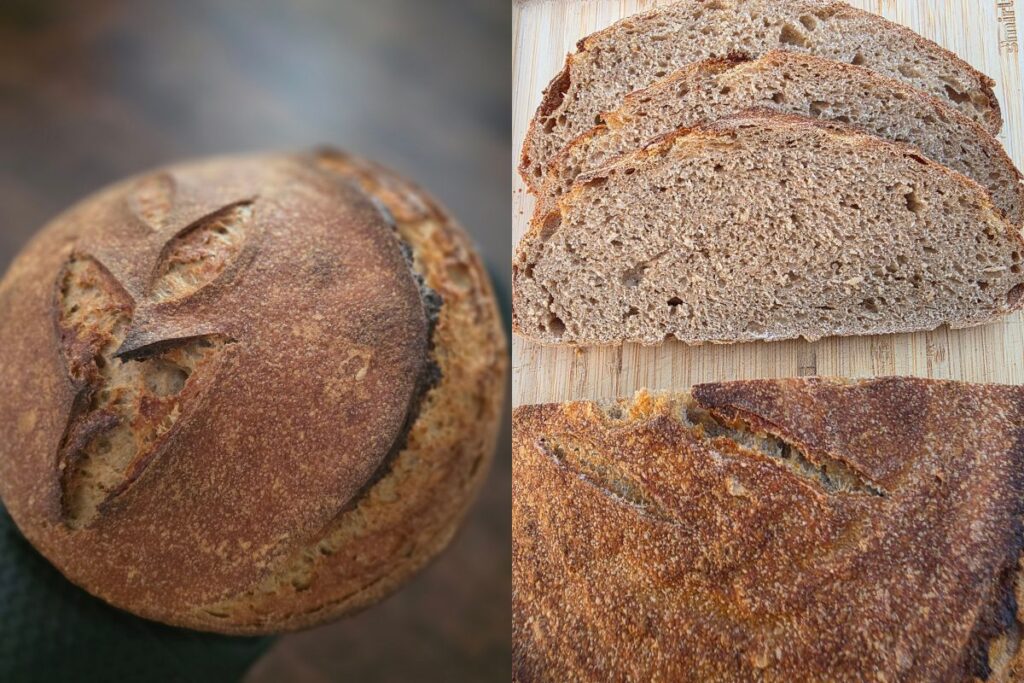
This post contains affiliate links, which means I make a small commission at no extra cost to you. As an Amazon Associate I earn from qualifying purchases. Please read our Disclosure Policy
Why You’ll Love This Recipe
- Made with 100% fresh milled flour
- No commercial yeast
- Simple enough for beginners
- Mixer and no-mixer instructions
- Great oven spring and soft crumb
- Easy enough my 6-year-old can make it
Why Fresh Milled Flour?
Fresh milled flour keeps the entire wheat berry intact, including the bran, germ, and endosperm. This means it delivers naturally occurring fiber, healthy fats, and essential nutrients in every bake. When you mill flour fresh, you preserve B vitamins, vitamin E, iron, zinc, and magnesium that disappear during commercial processing.
By using fresh milled flour, you support digestion, steady energy, and overall wellness — not just empty calories.
I have the NutriMill Classic. I use mine several times a week and have had no issues in over two years. It is a great, affordable grain mill.
Why Use Sourdough?
Sourdough fermentation actively breaks down complex carbohydrates and reduces phytic acid in the grain. This process helps your body absorb minerals more easily and improves digestion. The natural bacteria and wild yeast in sourdough also slow down how quickly your body processes carbohydrates, which supports balanced blood sugar.
Sourdough adds depth of flavor while improving the structure and texture of baked goods. When you combine sourdough with fresh milled flour, the two work together to create baked goods that taste better and feel more nourishing.
Find my simple, no fuss sourdough starter maintenance here.
Ingredients
- Fresh milled flour – I usually use half hard white wheat and half hard red wheat. I like adding about 50-100g Khorasan for an even softer fresh milled flour sourdough boule.
- Water
- Sourdough starter – for best results feed within 8 hours of using. Although I have made delicious bread with starter that was in the fridge a few days!
- Salt – I use Himalayan or sea salt
Equipment
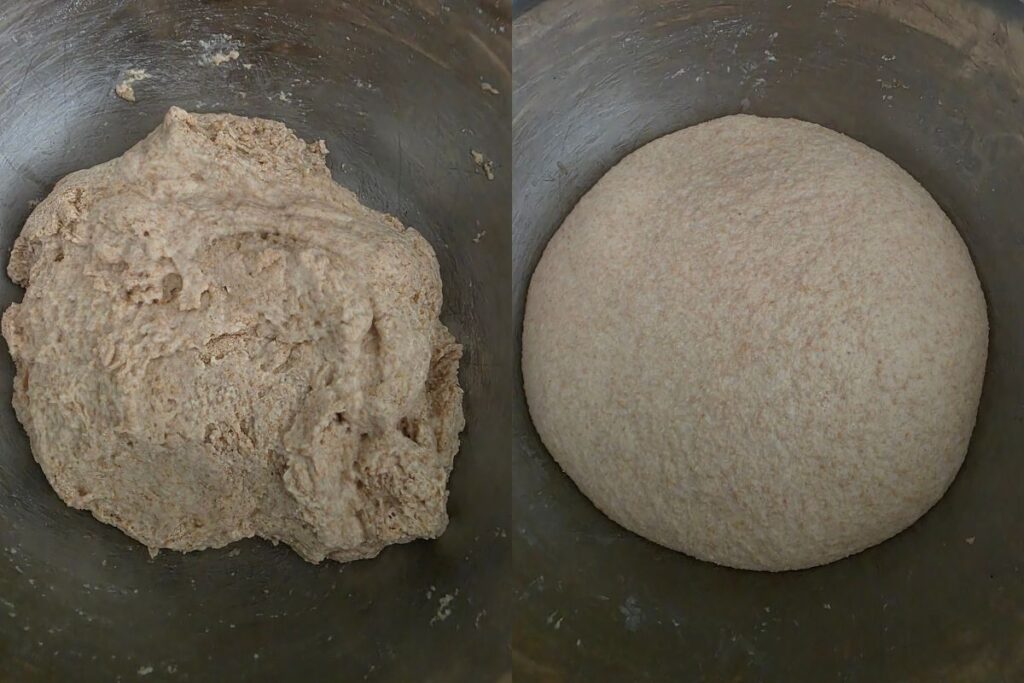
With each set of coil folds/stretch and folds you can see the texture of the dough change.
How to make Fresh Milled Flour Sourdough Bread
Method 1: Stand Mixer
Step 1: Mix
Add the flour, water, starter, and salt to the bowl of your stand mixer.
Mix on low speed just until everything comes together.
Cover and let the dough rest for 15–30 minutes.
Step 2: Knead
Using the dough hook, knead for about 8–10 minutes, or until the dough becomes smoother and more elastic.
Transfer to a lightly oiled bowl and cover.
Step 3: Coil Folds
Perform 3–4 sets of coil folds, spaced about 30 minutes apart. To coil fold – pick the dough up from the center, letting the sides drape and setting it down. Repeat 2-4 times, rotating the bowl to life from different angles.
After the final coil fold, leave the dough undisturbed until bulk fermentation is complete.
Method 2: No Mixer
Step 1: Mix
Add the flour, water, starter, and salt to your bowl. Combine until no dry flour remains.
Cover and rest 15–30 minutes.
Step 2: Stretch & Fold
Perform one set of stretch and folds by gently pulling each side of the dough up and folding it toward the center. Repeat 8-12 times moving all around the bowl.
Cover and rest 30 minutes.
Step 3: Coil Folds
Complete 3–4 sets of coil folds, every 30 minutes. To coil fold – pick the dough up from the center, letting the sides drape and setting it down. Repeat 2-4 times, rotating the bowl to life from different angles.
Allow the dough to continue bulk fermenting after the final fold.
Bulk Fermentation
Bulk fermentation is complete when the dough:
- looks puffy and airy
- has increased by roughly 40–60% (it doesn’t need to double)
- has a smooth, domed top
- jiggles slightly when the bowl is shaken
- has visible bubbles around the edges
The exact time depends on the temperature of your kitchen.
As a general guide:
- In the summer – 3-4 hours
- In the winter – 5-6 hours
Fresh milled flour tends to ferment a little faster than bread made with commercial white flour, so keep an eye on the dough rather than the clock. In my experience fresh milled flour sourdough bread is better to be on the under-proofed side than over-proofed.
Shape
Turn the dough onto a lightly floured surface.
Shape into a tight round by gently pulling the surface taut.
Place seam-side up into a floured banneton.
Cover. I like to use disposable shower caps for an easy cover.
Cold Proof
Refrigerate overnight, or for 12-24 hours. You can cold proof up to two days.
Bake
Preheat your Dutch oven to 450°F.
Turn the dough onto parchment paper or a bread sling.
Score with a sharp lame. Optionally, mist with water for extra steam.
Bake:
- 30 minutes covered
- 10 minutes uncovered
The loaf should be deep golden brown and register about 200–205°F internally.
Cool on a baking rack. Cooling completely before slicing allows the crumb to finish setting. Or if you are like my family – devour half the loaf while still warm! 🙂
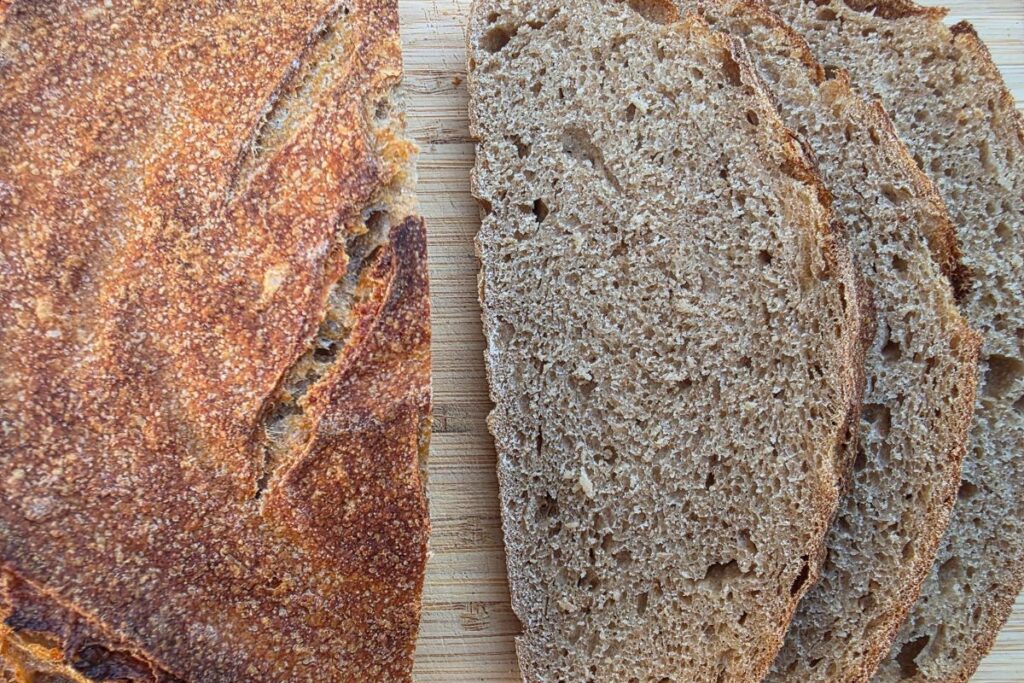
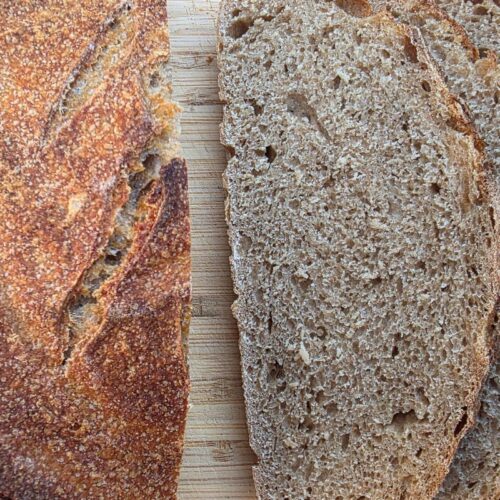
This loaf I didn’t follow any of the “rules”. Not active starter, no window pane, less coil folds, and baked it after only several hours in the fridge, and sliced warm. The result – a beautiful, delicious loaf!
FAQs
Do I need to mix till window pane?
No! While plenty kneading/coil folds are important for gluten development, I personally never check for window pane. Learn your dough and you can tell by the texture if it is well kneaded. See my photo above.
Can I use only hard white wheat?
Yes! Hard white makes a slightly lighter, milder loaf.
Can I use only hard red wheat?
Absolutely. Expect a heartier flavor and slightly denser crumb.
Can I add khorasan?
Yes. I often substitute part of the flour with khorasan, which creates a softer loaf with a rich, buttery flavor.
Why didn’t my dough double during bulk fermentation?
With fresh milled flour, I don’t wait for the dough to double. A 40–60% rise is usually perfect.
Can I bake the same day?
Yes. Once shaped, you can proof at room temperature until puffy and bake, but I prefer an overnight cold proof for better flavor and easier scoring.
Ideas to use Fresh Milled Sourdough Bread
- Chicken Salad Sandwiches
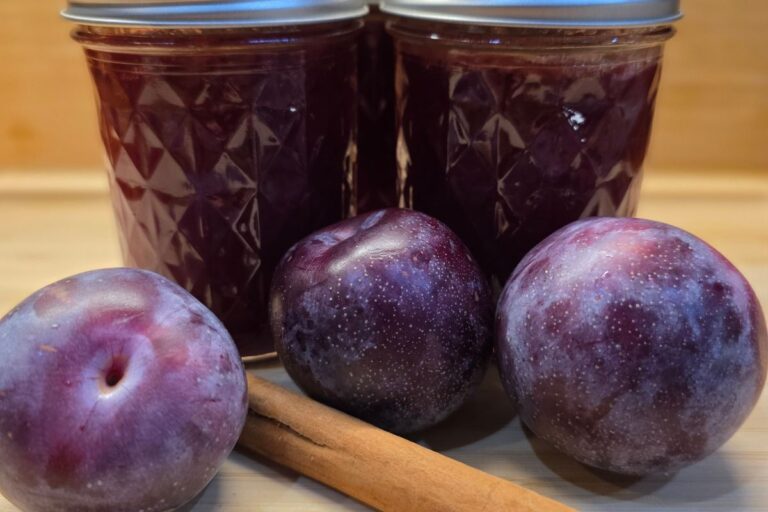
- Grilled Cheese. Try it with jam – it will seriously uplevel your grilled cheese! Spiced Plum Jam is one of my favorites.
- As a side for your dinner. A favorite for my family is if I time the loaf to pull out of the oven right at dinner time, and we get to enjoy a loaf of hot bread as the carb for our dinner! And honestly it’s a favorite for me too, as it’s an easy food to prep in advance for dinner.
Easy Fresh Milled Flour Sourdough Bread (100% Whole Wheat)
Equipment
- 1 dutch oven
- 1 kitchen scale
Ingredients
- 500 grams fresh milled flour I like a mix of hard white, hard red, and khorasan
- 375 grams water
- 100 grams active sourdough starter
- 12 grams salt
Instructions
Stand Mixer Instructions
- Add the flour, water, starter, and salt to the bowl of your stand mixer. Mix on low speed just until everything comes together. Cover and let the dough rest for 15–30 minutes.
- Using the dough hook, knead for about 8–10 minutes, or until the dough becomes smoother and more elastic. Transfer to a lightly oiled bowl and cover.
- Perform 3–4 sets of coil folds, spaced about 30 minutes apart. To coil fold – pick the dough up from the center, letting the sides drape and setting it down. Repeat 2-4 times, rotating the bowl to life from different angles.
- After the final coil fold, leave the dough undisturbed until bulk fermentation is complete.
No Mixer Instructions
- Combine all ingredients until no dry flour remains. Cover and rest 15–30 minutes.
- Perform one set of stretch and folds by gently pulling each side of the dough up and folding it toward the center. Repeat 4-8 times moving all around the bowl. Cover and rest 30 minutes.
- Complete 3–4 sets of coil folds, every 30 minutes. To coil fold – pick the dough up from the center, letting the sides drape and setting it down. Repeat 2-4 times, rotating the bowl to life from different angles. Allow the dough to continue bulk fermenting after the final fold.
Bulk Fermentation
- Bulk fermentation is complete when the dough:
- looks puffy and airy
- has increased by roughly 40–60% (it doesn’t need to double)
- has a smooth, domed top
- jiggles slightly when the bowl is shaken
- has visible bubbles around the edges
- The exact time depends on the temperature of your kitchen.
- As a general guide:
- In the summer – 3-4 hours
- In the winter – 5-6 hours
- Fresh milled flour tends to ferment a little faster than bread made with commercial white flour, so keep an eye on the dough rather than the clock. In my experience fresh milled flour sourdough bread is better to be on the under-proofed side than over-proofed.
Shape
- Turn the dough onto a lightly floured surface. Shape into a tight round by gently pulling the surface taut. Place seam-side up into a floured banneton.
- Cover. I like to use disposable shower caps for an easy cover.
Cold Proof
- Refrigerate overnight, or for 8–16 hours. You can cold proof up to two days.
Bake
- Preheat your Dutch oven to 450°F.
- Turn the dough onto parchment paper or a bread sling. Score with a sharp lame. Optionally, mist with water for extra steam.
- Bake:
- 30 minutes covered
- 10 minutes uncovered
- The loaf should be deep golden brown and register about 205–210°F internally.
- Cool on a baking rack. Cooling completely before slicing allows the crumb to finish setting. Or if you are like my family – devour half the loaf while still warm!
Did You Make This Recipe?
I’d love to hear how it turned out! If you enjoyed this recipe, please leave a ⭐⭐⭐⭐⭐ rating and a comment below. Your reviews not only make my day, but they also help other home bakers find and trust my recipes.
Save this recipe for later on Pinterest so it’s easy to find next time. While you’re there, follow Paradise Acres Homestead for more fresh milled flour recipes, sourdough baking, and from-scratch homestead favorites.




One Comment